
What this is
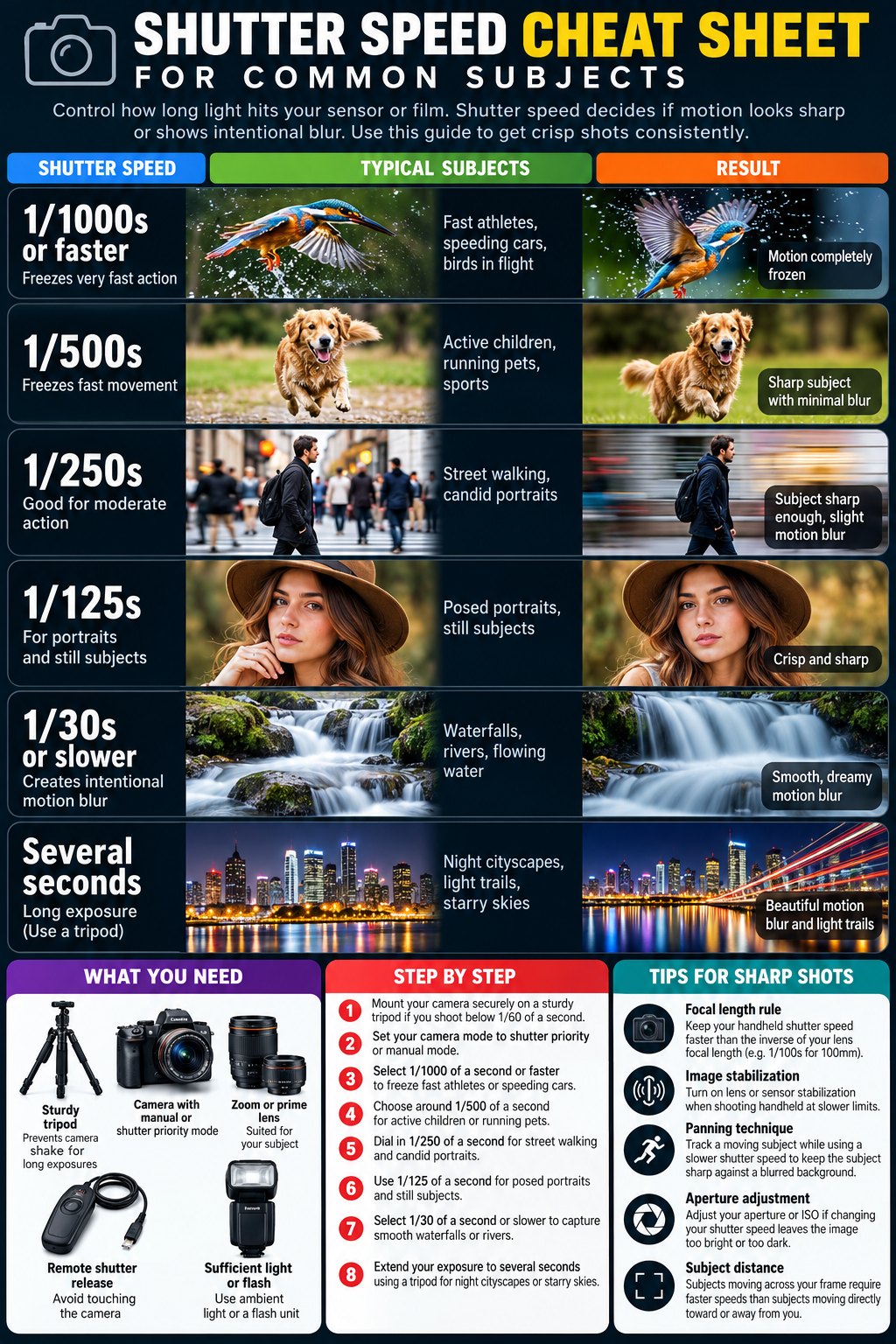
Controlling how long light hits your sensor or film is a core skill in photography. Shutter speed decides if moving parts in your frame look sharp or show intentional blur. This quick guide lists standard shutter times for everyday scenes so you get crisp shots consistently.
What you need
- A stable tripod to prevent camera shake during long exposures
- A camera with manual exposure mode or shutter priority mode
- A zoom or prime lens suited for your subject
- A remote shutter release cable to avoid touching the camera body
- Sufficient ambient light or a flash unit
Step by step
- Mount your camera securely on a sturdy tripod if you shoot below 1/60 of a second.
- Set your camera mode to shutter priority or manual mode.
- Select 1/1000 of a second or faster to freeze fast athletes or speeding cars.
- Choose around 1/500 of a second for active children or running pets.
- Dial in 1/250 of a second for street walking and candid portraits.
- Use 1/125 of a second for posed portraits and still subjects.
- Select 1/30 of a second or slower to capture smooth waterfalls or rivers with intentional blur.
- Extend your exposure to several seconds using a tripod for night cityscapes or starry skies.
Tips
- Focal length rule. Keep your handheld shutter speed faster than the inverse of your lens focal length.
- Image stabilization. Turn on lens or sensor stabilization when shooting handheld at slower limits.
- Panning technique. Track a moving subject in your viewfinder while using a slower shutter speed to keep the subject sharp against a blurred background.
- Aperture adjustment. Remember to adjust your aperture or ISO if changing your shutter speed leaves the image too bright or too dark.
- Subject distance. Subjects moving across your frame require faster speeds than subjects moving directly toward or away from you.